
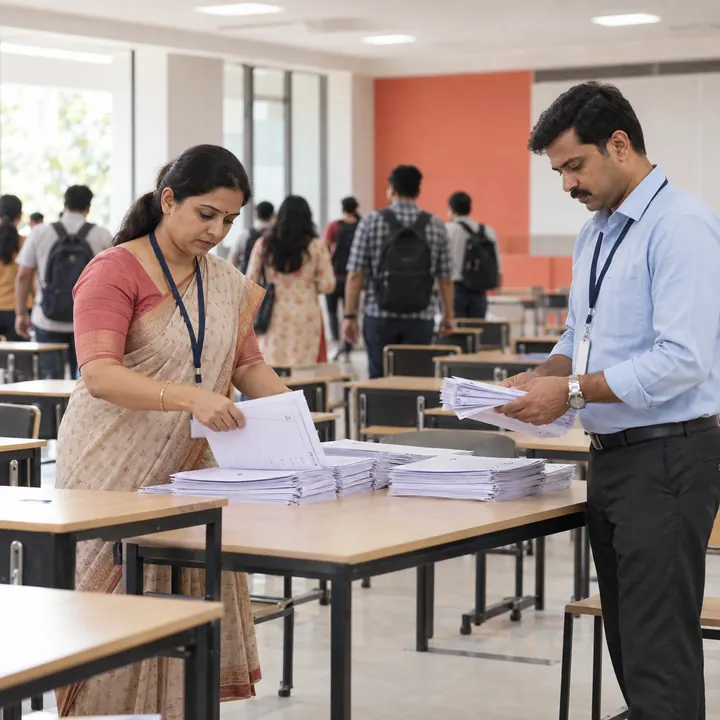
Centres are usually asked whether they can host an exam. The more useful question is which format the room in question is built for, because the two formats fail in completely different places.
Side by side
What CBT asks of the room
Everything in our nine-point centre check applies, and three items dominate: usable seats rather than installed machines, power backup rated for the whole session, and a second internet path someone has actually tested. A lab that fails any of those three is not a lab you can run a high-stakes CBT in, however good the seating is.
The compensating advantage is that CBT has almost no custody problem. There is no physical paper to lose, and no window between the exam ending and the scripts being secured.
What paper asks of the room
Paper is simpler to seat and much harder to secure. The material exists physically, and every point at which it changes hands is a point at which the chain can break.
- Storage before. A lockable room or cabinet that is not the general store cupboard, with controlled access and a record of who opened it and when.
- Handling space. Somewhere to open and count sealed packets that is not a corridor and not the exam hall with candidates in it.
- Distribution and collection. A route that lets invigilators hand out and take back material in a controlled sequence, with the counting done in the room.
- Storage after. The half everyone forgets. Completed scripts need the same security as blank papers, from the moment they are collected until they leave the building.
- Collection and packing area. Sorting, counting and sealing several hundred answer sheets takes a table and a quiet room, not a reception desk.
"We do both"
Many centres genuinely do. Very few do both in the same room to the same standard, and that is the distinction worth drawing out.
A computer lab has machines and power but usually no secure store, and its desks are sized for a keyboard rather than for a booklet and a separate answer sheet. A hall has the seating, the space and the spacing, but no infrastructure and often no lockable room nearby. Both statements can be true of one centre at the same time.
So ask about the room, not the centre:
- Which specific room runs CBT, and which runs paper?
- If it is the same room, what changes between the two configurations?
- Where is the secure storage in relation to that room, and who holds the key?
- What is the usable seat count in each configuration? They will differ.
Where format choice interacts with capacity
Paper scales with furniture; CBT scales with machines. That single difference drives most multi-city plans.
A city that can seat 400 for a written exam may top out at 80 for a CBT, because the hall is a hall and the lab is a lab. If your format is fixed, it constrains city selection and shift patterns — see planning a multi-city drive. If your format is still open, it is worth knowing that the same candidate volume can need a very different footprint depending on which way you go.