
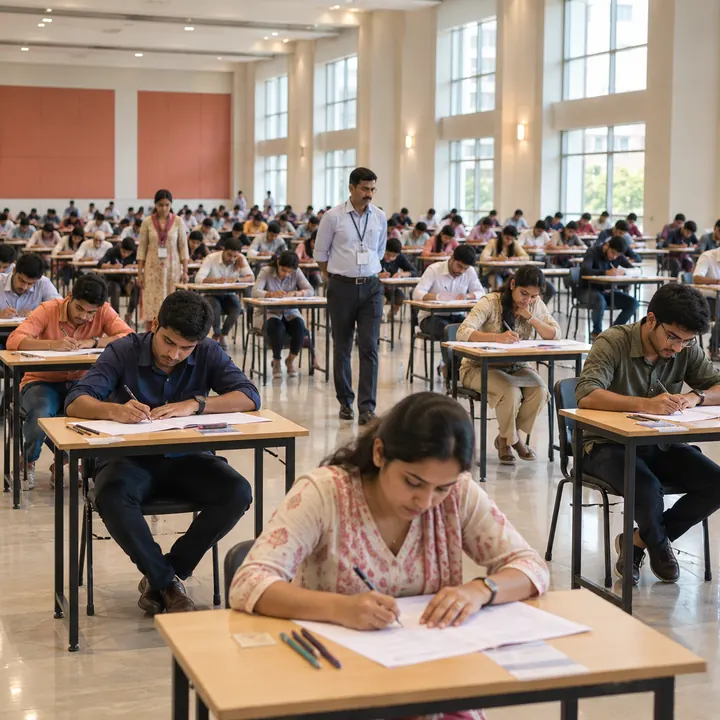
Two numbers get confused at the start of every drive. Registered is how many people are on your list. Attending is how many walk through the door. Booking against the first is how drives end up paying for empty rooms; ignoring the gap entirely is how they end up short a room on the morning.
The gap moves, and it moves predictably
We deliberately do not publish a percentage here. Attendance is specific enough to the exam, the employer and the city that a general figure would be worse than useless — it would be quoted. Last cycle's attendance for the same exam in the same city is the only number worth planning on. If this is your first cycle, plan a range rather than a point, and make sure the booking can flex.
The buffer, and what it is actually for
Once you have an attendance estimate, hold capacity above it. Our own rule is that confirmed seats should be at least 1.1 times the candidates mapped to that centre and shift. That ten per cent is not a hedge against the attendance estimate being wrong — it covers the things that go wrong inside the room:
- Workstations that fail between the readiness check and the session.
- Candidates who have to be moved mid-exam and need a working seat to move to.
- Spacing decisions made on the day that cost you a row.
- Late arrivals you choose to admit.
Without the buffer, the first failed machine turns into a candidate with no seat, and that is an incident rather than an inconvenience.
Over-allocation is a trade, not an error
It is common, and reasonable, to map more candidates to a centre than the seats you have booked — because you expect a proportion not to arrive. This is attendance arbitrage, and for a large low-stakes drive it is often the correct commercial call. Booking for a hundred per cent turnout that has never once happened is simply paying for empty chairs.
What makes it a trade rather than a gamble is that it is explicit: the over-allocation is visible at booking, logged, and somebody has answered the question "what do we do if more people turn up than we have seats for?" before the day. That answer is usually a second shift held in reserve, an agreement with the centre on overflow space, or a documented decision to turn candidates away and reschedule them. All three are survivable. Discovering the question at 9am is not.
When to split across shifts and centres
Splitting is not free. Every additional shift adds a changeover — candidates leaving while candidates arrive, a room to reset, a fresh identity-check queue. Every additional centre adds a whole set of readiness risks and another accountable person to brief.
Split when there is a reason:
- No venue at your size. Most cities have far more 60-seat rooms than 300-seat ones.
- Invigilation comfort. Past a certain room size, oversight degrades regardless of the ratio on paper.
- Blast radius. Two centres of 150 means a power failure costs you half a drive, not all of it.
- Candidate travel. Two cities at 100 each may beat one city at 200 for attendance — which feeds straight back into the first section.
A worked shape
Note what the figures are doing. The 240 never drives the booking. The 180 comes from history, not from a rule of thumb. The buffer protects the room, not the estimate. And the reserve is the answer to the over-allocation question, agreed in advance.